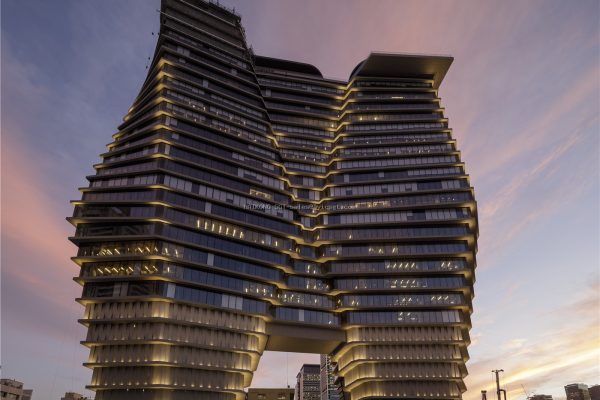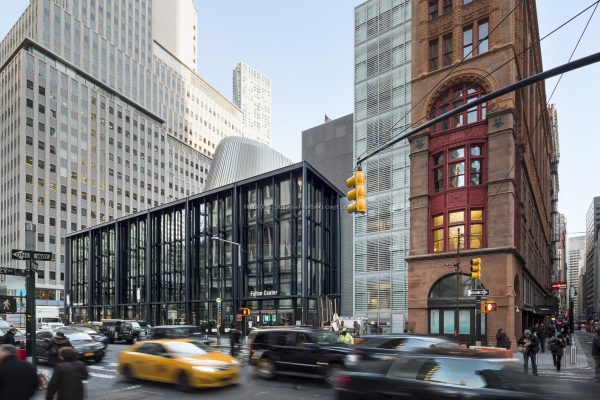
Urban noise affects more than hearing comfort. It can influence sleep quality, concentration, and overall psychological well-being. Therefore, architects increasingly choose acoustic laminated glass to reduce traffic noise, aircraft noise, and urban background sounds in modern buildings. For WELL-certified projects, luxury hotels, premium residences, and healthcare facilities, glass performance now focuses on psychoacoustic comfort rather than simple noise blocking.
However, many building projects still rely only on thicker glass to solve noise problems. This approach often fails when dealing with low-frequency sounds, including heavy trucks, railway vibration, and aircraft rumbling. The reason is that glass systems can experience the coincidence effect, which reduces sound insulation performance at specific frequencies.
How Acoustic Laminated Glass Improves Facade Sound Control
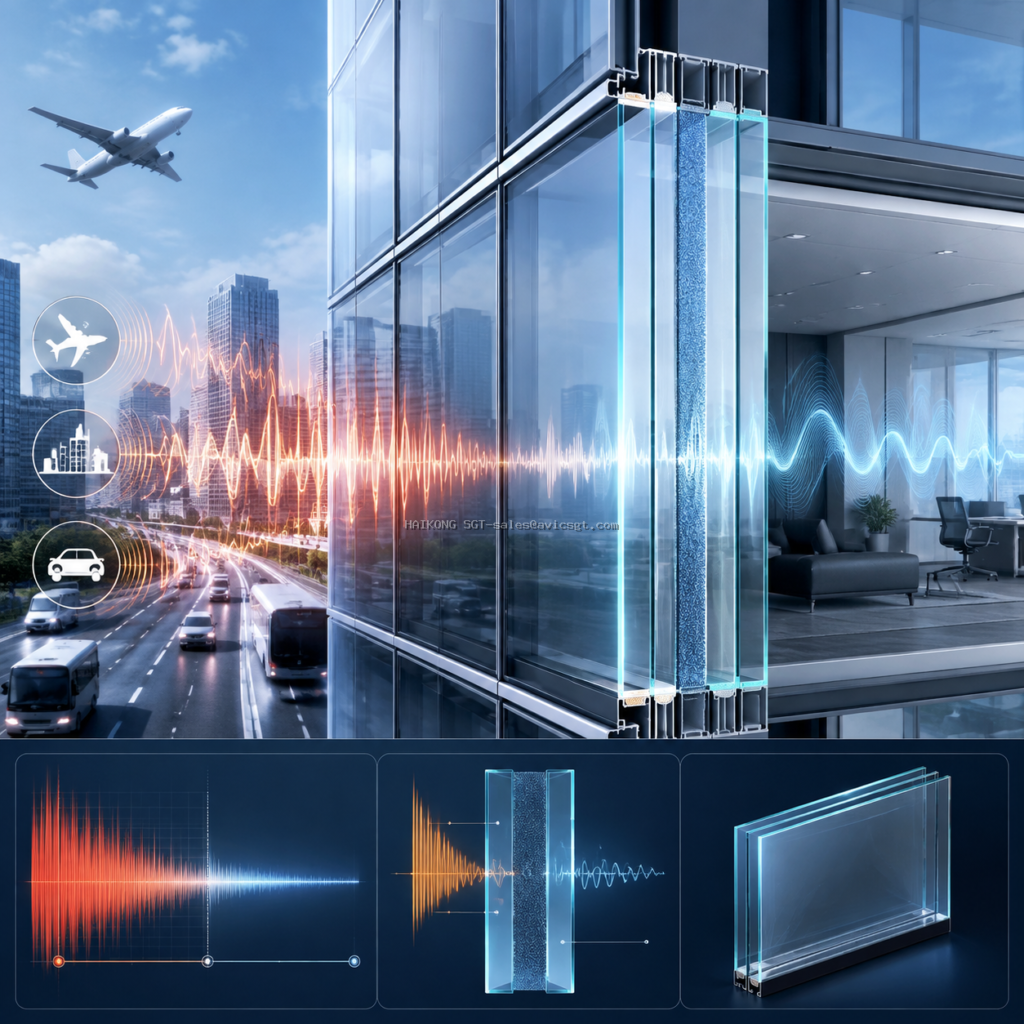
Acoustic laminated glass uses advanced Acoustic PVB interlayers to improve sound reduction performance.
Unlike standard PVB, Acoustic PVB features special viscoelastic properties. The soft-hard-soft polymer structure allows the interlayer to absorb vibration energy when sound waves reach the glass surface. As a result, the material converts mechanical vibration into heat energy and reduces sound transmission.
Compared with conventional laminated glass, Acoustic PVB solutions can provide:
- Approximately 3–5 dB improvement in Rw sound insulation performance
- Better control of low-frequency and mid-frequency noise
- Reduced vibration transmission through glass panels
- Improved indoor acoustic comfort without significantly increasing glass thickness
Why Ordinary PVB Cannot Control Low-Frequency Noise Effectively
Glass sound insulation depends on several physical factors, including thickness, stiffness, and resonance frequency.
When the vibration frequency of glass matches the incoming sound wave frequency, the system creates a coincidence dip. Consequently, sound insulation performance decreases within certain frequency ranges, especially around 1000Hz–3000Hz.
Therefore, simply increasing glass thickness does not always solve acoustic problems.
For example:
- Airport buildings face continuous aircraft noise exposure
- Railway projects experience low-frequency vibration
- Urban towers near highways receive constant traffic noise
In these situations, engineers need a combination of Acoustic PVB, optimized glass thickness, and proper facade design.
Guangdong Haikong Special Glass Technology Co., Ltd. provides high-performance architectural glass solutions based on more than 32 years of glass deep-processing experience. Moreover, SGT has completed more than 500 global projects and operates professional testing facilities equipped with Fourier Transform Infrared Spectrometer, Lambda 1050+ Spectrophotometer, optical testers, and color measurement equipment.
Acoustic Laminated Glass Selection Guide for Different Noise Environments
Different buildings require different acoustic glass configurations. Therefore, engineers should evaluate the surrounding sound environment before selecting a glazing system.
| Application Scenario | Main Noise Frequency | Recommended Sound Insulation Target |
|---|---|---|
| Airport areas and railway stations | Low and mid-frequency 100–500Hz | Rw / STC ≥45 dB |
| Urban highways and elevated roads | Mid and high-frequency 500–2000Hz | Rw / STC ≥40 dB |
| Healthcare facilities and consultation rooms | Full-frequency background noise | Rw / STC ≥48 dB |
When you select an acoustic glazing system, consider:
- External noise source characteristics
- Building usage requirements
- Curtain wall structure
- Glass thickness combination
- PVB or SGP interlayer performance
Acoustic Laminated Glass Manufacturing Process
SGT controls every production stage to ensure reliable glass performance. The manufacturing process includes:
1. Glass Cutting and Processing
SGT cuts glass sheets according to project dimensions. Engineers complete drilling, edge processing, and other customized treatments before lamination.
2. Glass Cleaning
Technicians carefully clean and dry the glass surface. This step ensures strong adhesion between the glass and polymer interlayer.
3. Interlayer Assembly
SGT places PVB, SGP, EVA, or PU interlayers between glass sheets according to project requirements.
4. Pre-Lamination
The production team removes trapped air through roller equipment. Therefore, the glass achieves initial bonding before autoclave processing.
5. Autoclave Bonding
Finally, SGT applies controlled heat of approximately 120–150°C and pressure of 10–14 bar. As a result, the interlayer permanently bonds with the glass to form a stable laminated structure.
Structural Design Tips for Better Acoustic Performance
Selecting the right laminated glass sound insulation solution requires more than choosing a suitable interlayer. Glass configuration also directly affects acoustic results.
Use Asymmetric Glass Thickness Design
Engineers should avoid symmetrical insulated glass structures such as:
6+12A+6
Because both glass panels have similar thickness, they may create similar resonance frequencies.
Instead, engineers often select:
8+12A+6
This asymmetric design changes vibration behavior and helps reduce sound transmission.
Laminated Glass vs Acoustic Laminated Glass
| Feature | Standard Laminated Glass | Acoustic Laminated Glass |
|---|---|---|
| Main Purpose | Safety protection | Safety and noise reduction |
| Interlayer | Standard PVB | Acoustic PVB |
| Low-frequency Control | Limited | Improved |
| Typical Applications | Windows and doors | Facades, hotels, hospitals, premium buildings |
FAQ
1. What is the difference between Acoustic PVB and standard PVB?
Acoustic PVB uses advanced damping technology to absorb sound vibration. Meanwhile, standard PVB mainly focuses on safety and glass fragment retention.
2. Can thicker glass always provide better noise reduction?
No. Although thicker glass improves some acoustic performance, engineers must also consider resonance effects, glass configuration, and interlayer selection.
3. Where can Acoustic Laminated Glass be applied?
Architects commonly use it in curtain walls, airports, hospitals, hotels, offices, luxury residences, and buildings located in high-noise environments.
Conclusion
Choosing the correct acoustic laminated glass system helps buildings achieve better noise control and improve psychological comfort. Through Acoustic PVB technology, optimized thickness design, and professional glass processing, architects can balance safety, energy efficiency, and acoustic performance.
With over 32 years of glass deep-processing expertise, 500+ global projects, and advanced laboratory testing capabilities, SGT delivers customized laminated glass solutions for curtain walls, commercial buildings, and high-end residential developments.
If you need acoustic glass selection guidance, facade noise reduction solutions, or customized laminated glass products, contact SGT for professional project support and technical consultation.