When a high-rise facade fails, tempered glass breakage can quickly become a complex dispute involving owners, contractors, installers, and glass manufacturers. The key question is often difficult to answer: was it caused by a manufacturing defect, transportation damage, installation stress, or external impact?
For architects and project owners, identifying the real failure cause requires more than visual inspection. Through professional forensic glass analysis and fracture morphology examination, engineers can trace the origin of cracks and analyze the physical evidence preserved on the glass fracture surface.
As an experienced architectural glass supplier, HAIKONG SGT combines more than 30 years of glass deep processing experience with quality control systems to support global construction projects with reliable evidence-based glass solutions.
Why Tempered Glass Failure Analysis Matters in Curtain Wall Projects
Modern curtain walls often use large-format tempered glass panels because they provide high strength, thermal resistance, and safety fragmentation characteristics. However, when glass breaks after installation, responsibility can become difficult to determine.
A damaged facade panel may involve several possible causes:
- Manufacturing-related issues, such as nickel sulfide (NiS) inclusions causing spontaneous breakage
- Transportation or handling damage, including invisible edge micro-cracks
- Installation stress, caused by improper fitting or excessive frame pressure
- External impact, such as construction tools, objects, or accidental collision
- Thermal stress, caused by uneven temperature distribution across the glass surface
Because glass is a brittle material, the moment of fracture leaves permanent microscopic evidence. These fracture marks cannot be recreated, making them valuable for engineering investigations.
Forensic Glass Analysis: Reading the Physical Evidence of Glass Fracture
Fractography Reveals the True Crack Origin
Fractography is a scientific method used to analyze fracture surfaces and determine how failure started.
For tempered glass failure analysis, specialists examine:
- Crack origin location
- Fracture direction
- Surface markings
- Stress patterns
- Microscopic particles inside the fracture zone
Using optical inspection and scanning electron microscopy (SEM), engineers can identify whether the failure started internally, from the edge, or from an external force.
This approach helps separate manufacturing responsibility from installation or operational damage.
Three Typical Tempered Glass Breakage Patterns
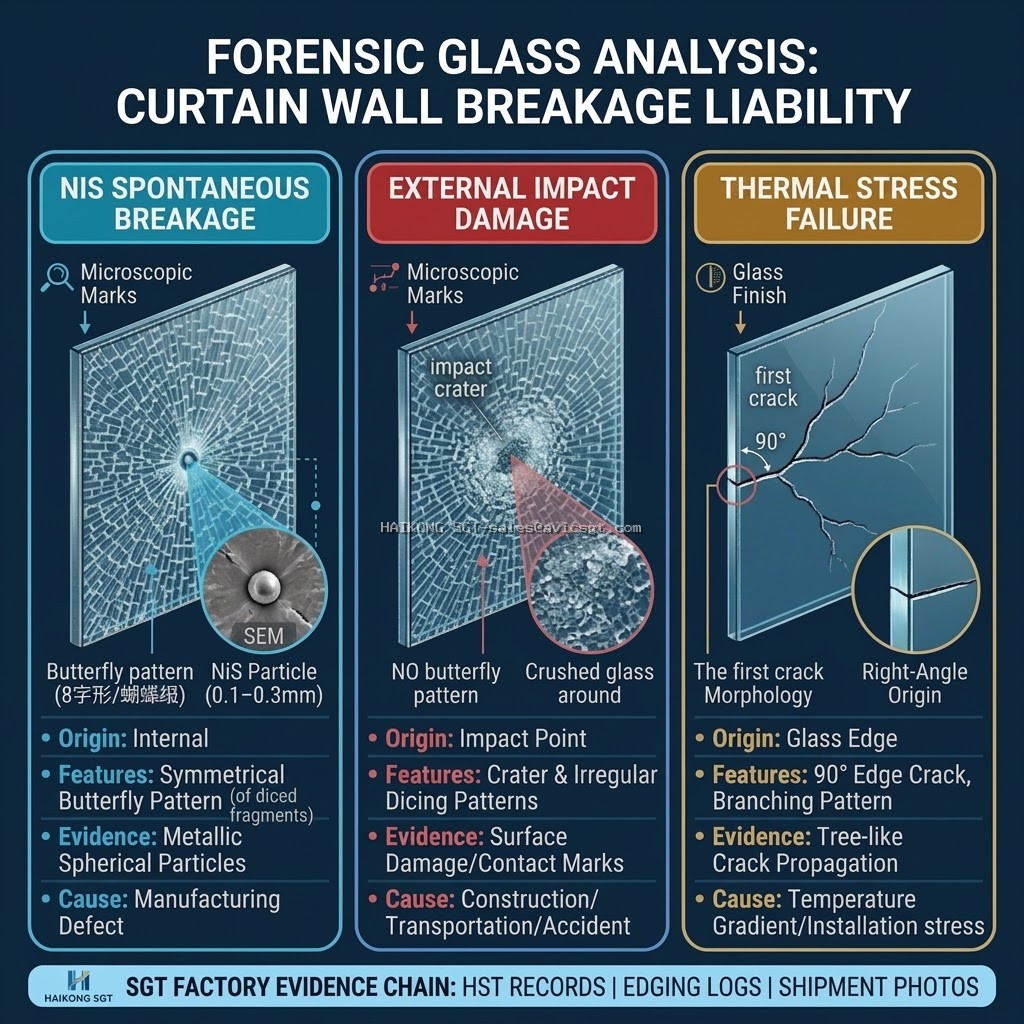
1. NiS Spontaneous Breakage in Tempered Glass
Nickel sulfide (NiS) inclusion is one known risk associated with fully tempered glass. During the tempering process, microscopic NiS particles may remain trapped inside the glass.
Over time, these particles can undergo phase transformation and create internal stress.
Typical identification features include:
- A characteristic butterfly pattern (Butterfly Pattern) around the crack origin
- A symmetrical “eight-shaped” fracture mark near the starting point
- SEM observation may reveal metallic spherical NiS particles with a diameter of approximately 0.1–0.3 mm
For large curtain wall projects, HAIKONG SGT recommends quality documentation such as heat soak testing records to reduce uncertainty after installation.
2. External Impact Damage
Impact-related breakage usually leaves different fracture evidence compared with NiS failure.
Typical characteristics include:
- A visible impact crater at the initiation point
- Multiple radial cracks extending outward
- Irregular fracture distribution
- No symmetrical butterfly pattern around the origin
This type of damage often indicates external force rather than internal glass quality problems.
3. Thermal Stress or Thermal Shock Failure
Temperature differences can create uneven stress inside glass panels, especially in large architectural glazing systems.
Typical thermal fracture characteristics include:
- Crack origin located at the glass edge
- The first crack usually forms at approximately 90° perpendicular to the edge
- Cracks develop into branching patterns similar to tree structures
Proper glass specification and installation methods are important to reduce thermal stress risks in curtain wall applications.
How SGT Builds a Quality Evidence Chain Before Shipment
A reliable glass manufacturer does more than produce products. It creates traceable quality records that help protect global construction projects.
HAIKONG SGT applies professional testing and inspection procedures for architectural glass, including:
- Heat Soak Test (HST) to reduce NiS-related risks
- Edge grinding and polishing inspection data
- Optical performance testing
- Thermal performance verification
- Packing and shipment documentation
SGT’s laboratory is equipped with professional testing instruments, including:
- Fourier Transform Infrared Spectrometer
- Lambda 1050+ Spectrophotometer
- 60° Angle Optical Tester
- CM700D Portable Color Difference Meter
These systems allow SGT to evaluate optical, thermal, and color performance according to international project requirements.
Tempered Glass Quality Control Process Before Delivery
For large-scale architectural projects, SGT follows a structured production process:
- Glass Cutting
- Cut panels according to project drawings
- Complete holes, notches, and edge processing before tempering
- Edge Processing
- Perform precision edging and polishing
- Reduce potential edge stress concentration
- Tempering Process
- Apply controlled heating and rapid cooling
- Create surface compression for improved strength
- Inspection and Documentation
- Verify product performance
- Record quality data before shipment
This process supports applications including curtain walls, windows, doors, railings, skylights, and custom architectural glazing projects.
FAQ
1. Can tempered glass break without external impact?
Yes. Tempered glass can occasionally experience spontaneous breakage due to internal factors such as NiS inclusions. Professional fracture analysis helps determine whether the failure originated inside the glass.
2. How can you tell if curtain wall glass failed because of installation problems?
Engineers analyze the crack origin, edge condition, installation pressure marks, and fracture direction. Edge-origin cracks and stress concentration patterns may indicate installation-related issues.
3. Does heat soak testing completely eliminate tempered glass breakage risk?
No. Heat soak testing can significantly reduce the risk associated with critical NiS inclusions, but it cannot eliminate every possible cause of glass failure.
Conclusion
For modern buildings, tempered glass provides essential strength, safety, and architectural flexibility. However, when curtain wall glass breaks, determining responsibility requires scientific evidence rather than assumptions. Through forensic glass analysis, fracture morphology, microscopic inspection, and complete manufacturing records, project teams can identify the real failure mechanism.
With more than 30 years of glass deep processing experience, HAIKONG SGT supports architects, developers, and contractors with reliable architectural glass solutions, including custom tempered glass panels and curtain wall glazing systems.
Get Professional Glass Failure Analysis Support from SGT
If your project requires tempered glass quality evaluation, failure investigation, or customized architectural glass solutions, contact HAIKONG SGT for technical consultation and project support. Our engineering team can provide professional analysis based on glass structure, fracture evidence, and manufacturing records.