In architectural glass systems, edge finishing plays an important role in structural performance and long-term stability. However, in curtain wall systems, frameless glass structures, and high-rise facade applications, edge conditions directly affect how glass performs under installation stress and environmental load.
Therefore, glass edge quality is not only a finishing detail but also a structural parameter in modern facade engineering.
At Haikong SGT, we process architectural glass using CNC-controlled systems. In addition, we maintain consistent edge quality across large-scale production for international building projects.
Glass Edge Behavior in Architectural Applications
In real construction environments, glass edge issues appear at different stages of the project lifecycle. For example, they often occur during fabrication, transportation, and installation.
However, these issues usually start from microscopic defects such as edge micro-cracks or stress concentration zones.
When wind load, thermal expansion, or structural deflection occurs, these weak points may expand into cracks. Therefore, glass edge finishing becomes a critical factor in controlling long-term structural behavior.
In addition, proper edge processing helps reduce installation-related risks in facade systems.
Comparison of Glass Edge Finishing Methods
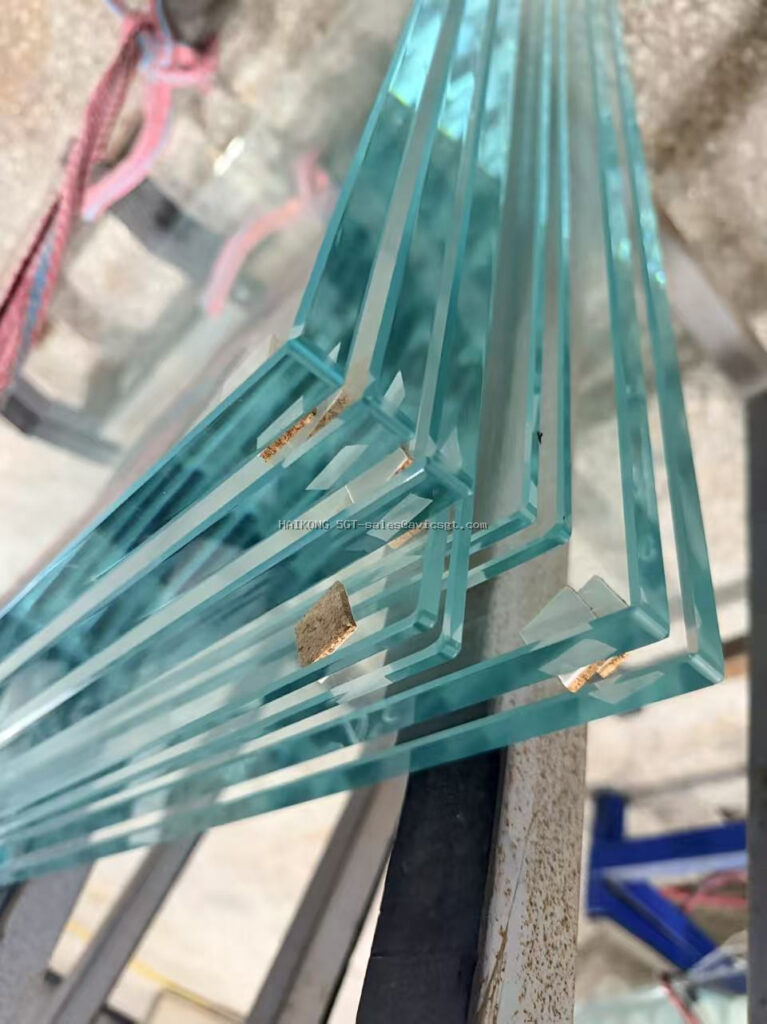
Edge finishing should be evaluated based on structural performance rather than appearance. In fact, different edge types serve different engineering purposes.
| Edge Type | Structural Performance | Application Scope | Risk Level |
|---|---|---|---|
| Ground Edge | Basic stability | Concealed systems | Medium |
| Seamed Edge | Basic edge safety | Interior glass | Medium–High |
| Polished Glass Edge | High structural integrity | Curtain wall, frameless systems | Low |
Therefore, polished glass edge is widely used in exposed architectural systems. Meanwhile, lower-grade edge finishes are usually limited to non-exposed applications.
When Polished Glass Edge Becomes Necessary
In many architectural projects, edge conditions determine system safety and installation reliability. For example, polished glass edge is commonly used in the following situations:
- curtain wall systems with exposed glass edges
- frameless glass balustrade structures
- point-supported structural glass systems
- frameless doors and partition systems
- high-end façade systems with visible edge design
In these applications, glass edges are part of the structural and visual system. Therefore, edge quality directly affects installation stability.
In addition, using lower-grade edge finishing may increase handling damage and installation risk.
Manufacturing Process and Quality Control
At HAIKONG SGT, we use CNC-based production systems for glass edge processing. This ensures consistent accuracy across architectural glass panels.
The process includes several controlled steps:
- CNC edge shaping for dimensional precision
- multi-stage grinding to remove micro-defects
- water-cooled polishing to reduce thermal stress
- optical inspection for edge quality control
As a result, edge consistency is maintained across large-scale facade projects.
In addition, for coated glass such as Low-E glass, we apply controlled dry processing. This helps protect coating performance while maintaining edge stability.
Lifecycle Impact of Glass Edge Quality
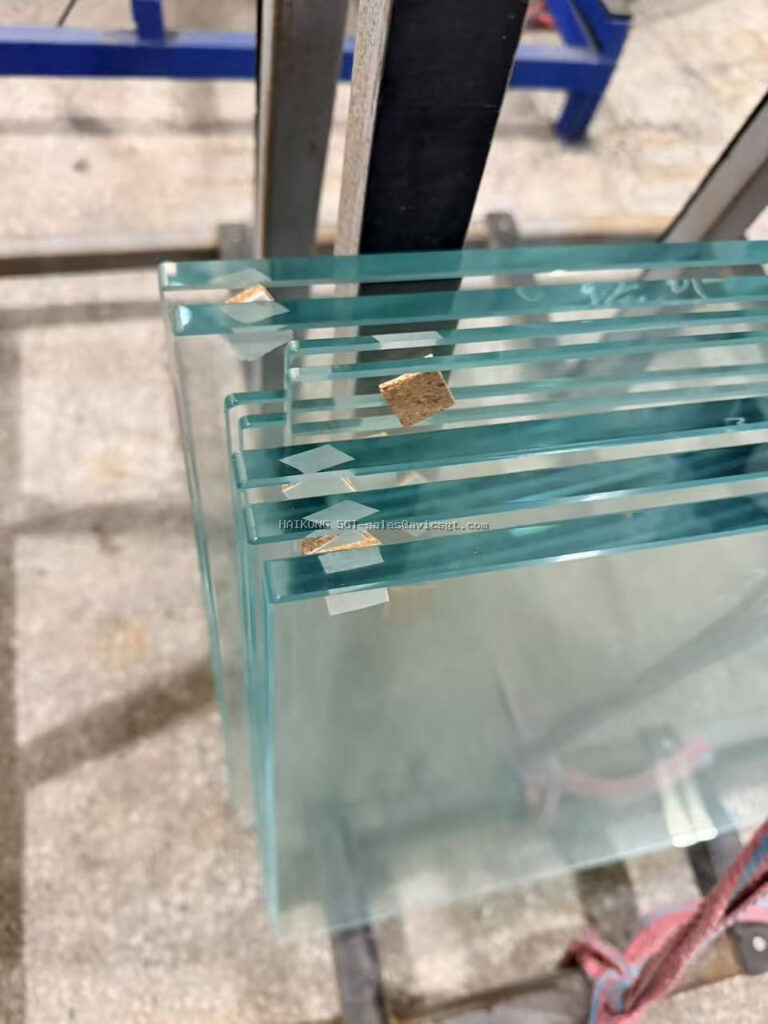
Glass edge finishing directly affects long-term performance in architectural systems. For example, non-polished edges may increase sensitivity to impact during transport and installation.
However, polished glass edges reduce the probability of:
- edge chipping during handling
- crack propagation under structural load
- installation failures in façade systems
- early replacement of glass panels
- visual defects during project inspection
Therefore, edge quality should be considered as part of long-term system stability rather than a simple processing step.
In addition, consistent edge finishing improves installation efficiency in large-scale projects.
Role of HAIkong SGT in Architectural Glass Manufacturing
Haikong SGT provides integrated manufacturing solutions for architectural glass systems.
We handle the full production chain, including:
- glass cutting and edge processing
- tempered glass production
- laminated glass manufacturing
- insulated glass production
- automated handling systems for façade projects
Therefore, we ensure consistent quality across curtain wall and frameless structural applications.
In addition, our system supports large-scale international architectural projects with strict quality requirements.
FAQ
Q1: Why is glass edge quality important in architectural projects?
Because it directly affects structural strength, crack resistance, and long-term stability in facade and frameless systems.
Q2: When should polished glass edge be used?
It is required for curtain walls, frameless balustrades, point-supported glass, and high-end exposed edge applications.
Conclusion
Polished glass edge is a structural processing method that directly affects the performance of architectural glass systems. However, its importance becomes more evident in curtain wall systems, frameless structures, and high-rise facade applications.
Therefore, glass edge quality should be evaluated as part of overall structural design rather than a visual enhancement.
In addition, as architectural systems become more complex, edge finishing continues to play an important role in ensuring stability, safety, and long-term performance.