Glass balustrades are widely used in residential buildings, commercial projects, shopping malls, and public spaces. As a critical safety component, choosing the correct tempered laminated glass specification is essential for structural performance, design approval, and long-term reliability. Poor glass selection may lead to project delays, redesign costs, and potential safety risks. Therefore, architects and engineers should evaluate glass thickness, wind loads, support systems, and safety standards before making a final decision.
Tempered laminated glass combines the strength of tempered glass with the safety benefits of laminated construction. It offers excellent impact resistance and keeps broken glass fragments bonded to the interlayer after breakage, reducing the risk of injury. HAIKONG SGT provides customized laminated glass solutions for residential, commercial, and high-rise architectural projects worldwide.
Why Choose Tempered Laminated Glass for Glass Balustrades?
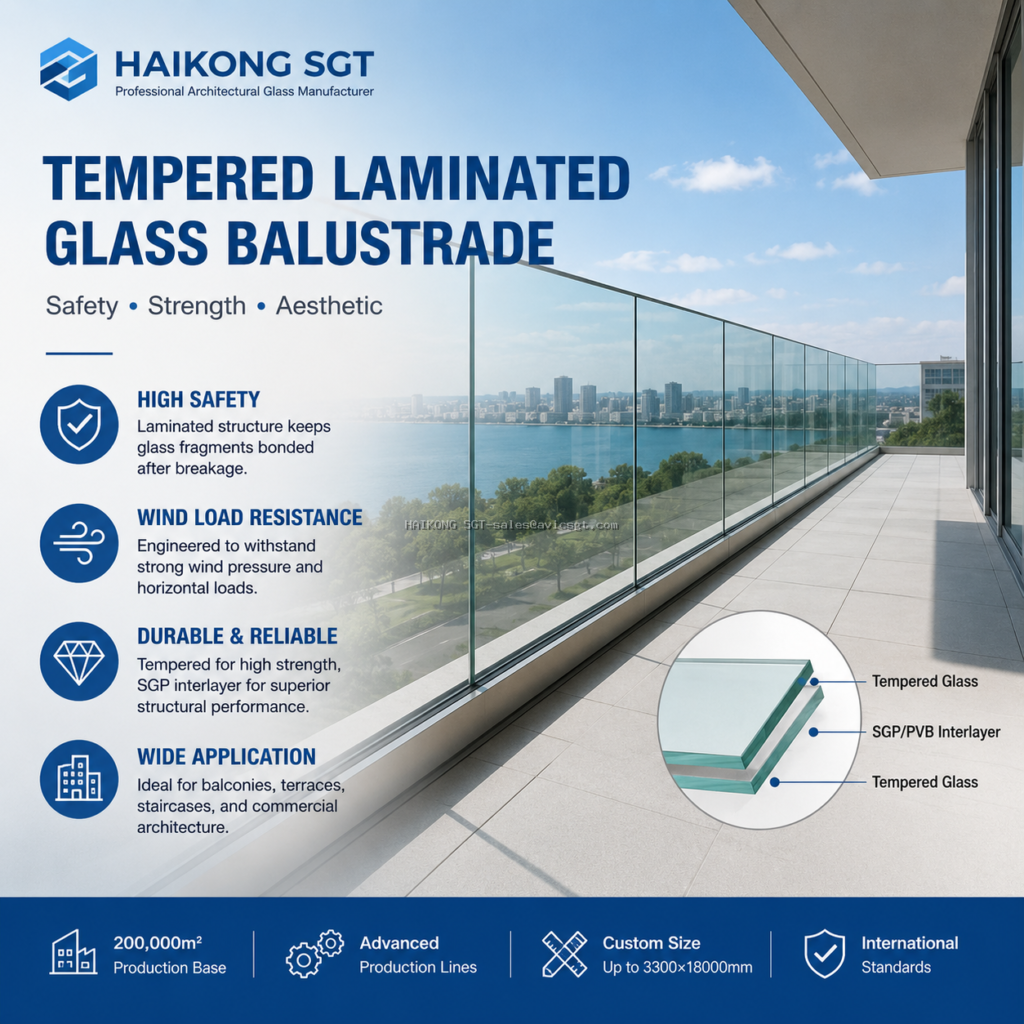
Manufacturers produce tempered laminated glass by bonding two or more tempered glass panels with a high-performance interlayer such as PVB or SGP. Compared with ordinary annealed glass, this structure provides significantly higher safety and durability. Moreover, the laminated construction helps maintain panel integrity even after accidental breakage.
Key advantages include:
- Higher bending strength than ordinary glass
- Excellent thermal shock resistance
- Improved impact resistance
- Reduced risk of dangerous glass fallout
- Compliance with international standards such as EN 12150 and ASTM C1048
Because structural balustrades require reliable post-breakage performance, engineers usually specify tempered laminated glass instead of monolithic tempered glass. As a result, it has become the preferred choice for balconies, staircases, terraces, and public buildings.
Structural Design Considerations
The structural behavior of a glass balustrade depends on its support system. Therefore, engineers should evaluate both the glass panel and the fixing method before selecting the appropriate glass thickness.
Frameless balustrades fixed with a bottom shoe work like cantilever beams. Since there are no vertical posts, the glass carries most of the bending load. Consequently, frameless systems generally require thicker tempered laminated glass, while SGP interlayers provide additional stiffness and improve post-breakage stability.
In contrast, framed or post-supported balustrades distribute part of the horizontal load through metal posts and surrounding frames. This design reduces stress on the glass and allows greater flexibility in glass thickness selection. However, laminated safety glass remains essential because it continues to provide protection if the glass breaks.
Recommended Tempered Laminated Glass Thickness
The required thickness depends on building height, wind pressure, glass span, fixing method, and local building regulations. For example, residential projects often use thinner laminated glass than commercial or high-rise applications.
Typical recommendations include:
- Residential balconies: 6+6mm tempered laminated glass
- Commercial buildings: 8+8mm tempered laminated glass
- High-rise balconies: 10+10mm or 12+12mm tempered laminated glass
- Public atriums: 12+12mm SGP tempered laminated glass
For buildings higher than 24 meters, engineers may specify stronger laminated glass structures or additional top rails to improve safety after accidental breakage. Therefore, selecting the correct glass configuration is essential for both compliance and long-term performance.
Why Choose SGP Interlayers?
The interlayer plays a critical role in the performance of tempered laminated glass. Although PVB performs well in many standard applications, SGP provides greater structural strength and durability for demanding environments.
Compared with PVB, SGP offers:
- Higher residual stiffness after breakage
- Better load-bearing capacity
- Improved edge stability
- Stronger resistance to moisture and delamination
As a result, architects frequently select SGP tempered laminated glass for exposed balconies, exterior railings, and structural glass systems where higher safety margins are required.
HAIKONG SGT: Professional Tempered Laminated Glass Manufacturer
HAIKONG SGT is an experienced China glass fabrication factory specializing in architectural glass solutions. With a 200,000m² production base in Huizhou, Guangdong, the company delivers high-quality glass products for projects around the world.
The factory features:
- 5 automated tempering lines
- 3 laminated glass production lines
- 4 insulating glass lines
- European-standard heat soak furnaces
- Large-format glass processing equipment
Moreover, HAIKONG SGT supports glass sizes up to 3300 × 18000 mm and provides customized solutions including tempered laminated glass, SGP laminated glass, heat strengthened glass, Low-E insulated glass, and other architectural glass products. Professional engineering support and advanced manufacturing capabilities help customers complete projects efficiently and safely.
FAQ
Q1: Is tempered laminated glass suitable for high-rise balconies?
Yes. Tempered laminated glass is widely used in high-rise buildings because the interlayer keeps broken glass in place and improves safety after impact.
Q2: Why is SGP preferred for glass balustrades?
SGP provides higher stiffness, better structural retention after breakage, and stronger resistance to moisture than traditional PVB interlayers.
Conclusion
Selecting the right tempered laminated glass for a glass balustrade requires careful consideration of thickness, wind loads, structural design, interlayer performance, and safety standards. Therefore, engineers should choose laminated safety glass that meets both project requirements and local regulations. With advanced manufacturing technology, professional engineering expertise, and extensive project experience, HAIKONG SGT delivers customized tempered glass solutions that combine structural safety, long-term durability, and modern architectural aesthetics.