

PRODUCT DETAILS
| Parameter | Specification |
|---|---|
| Maximum Size | Up to 3100 × 12000 mm |
| Glass Thickness | 5 – 25 mm |
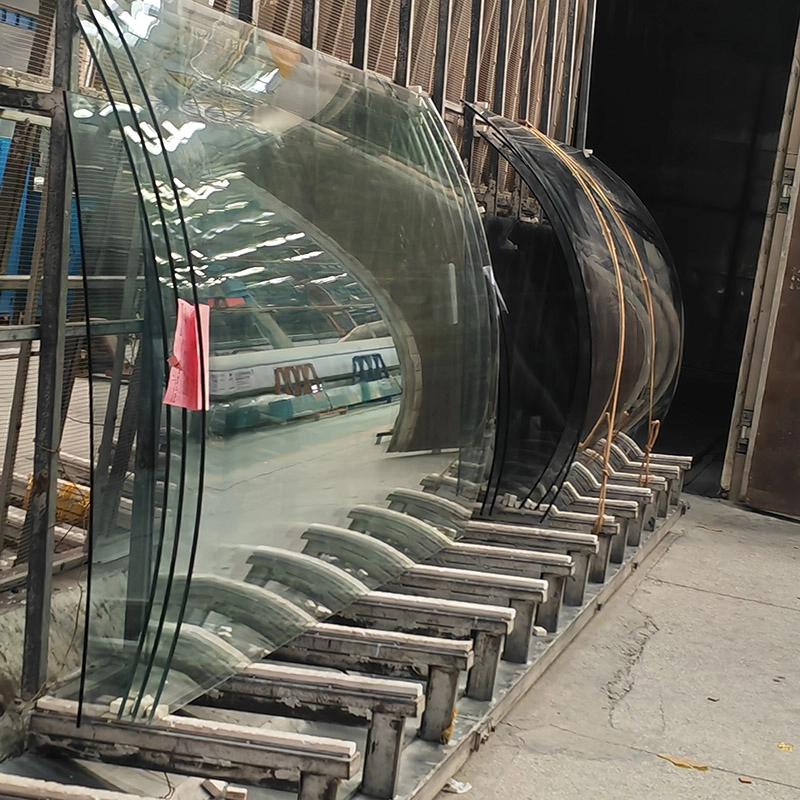
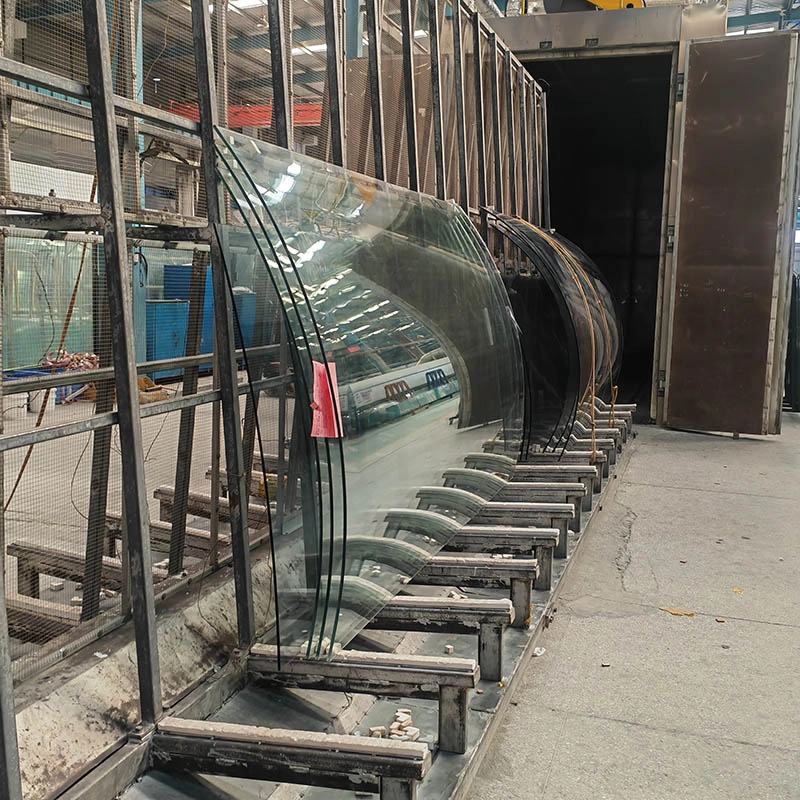
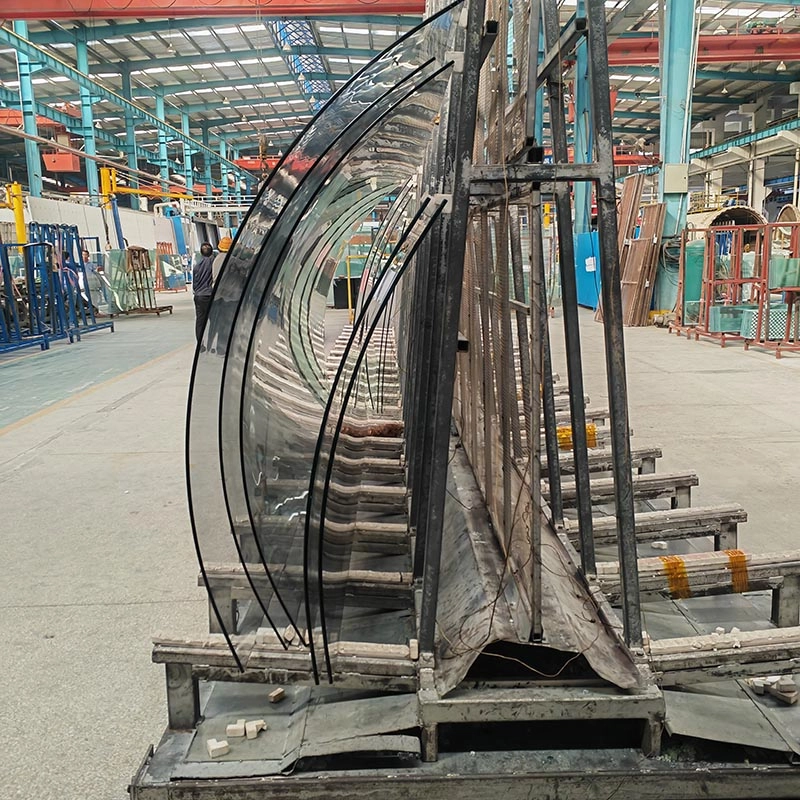
| Curvature Type | Single curvature, multi-curvature, arc-shaped, and bent profiles |
| Strength | 3–5 times stronger than standard annealed glass |
| Fragmentation | Breaks into small blunt particles; compliant with safety standards |
| Composite Options | Available as insulated, laminated, Low-E, ceramic fritted, or digital printed glass |
| Applications | Curved curtain walls, observation elevators, curved windows & doors, canopies, and architectural decorative structures |
PROCESSING ROUTE
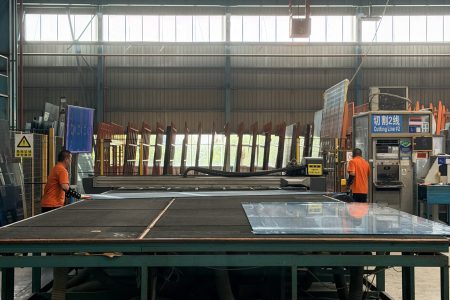
Cutting
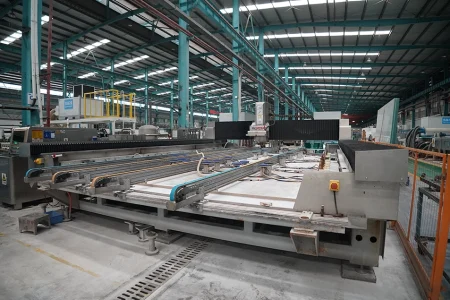
Edging
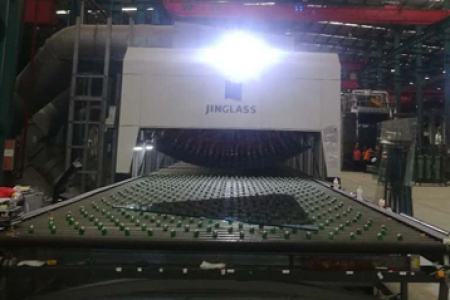
Tempering
Bent Tempered Glass: Curved Safety Glass for Modern Architecture
In contemporary architecture, straight lines no longer define the skyline. Curved facades, flowing glass canopies, and seamless spiral staircases have become hallmarks of landmark buildings worldwide. At the heart of this design revolution is bent tempered glass—a material that combines the strength and safety of tempered glass with the elegance of curved forms.
This comprehensive guide explores everything you need to know about bent tempered glass: how it is made, its advantages and limitations, the challenge of heat soak testing for curved glass, and how to specify the right product for your architectural project.
What Is Bent Tempered Glass?
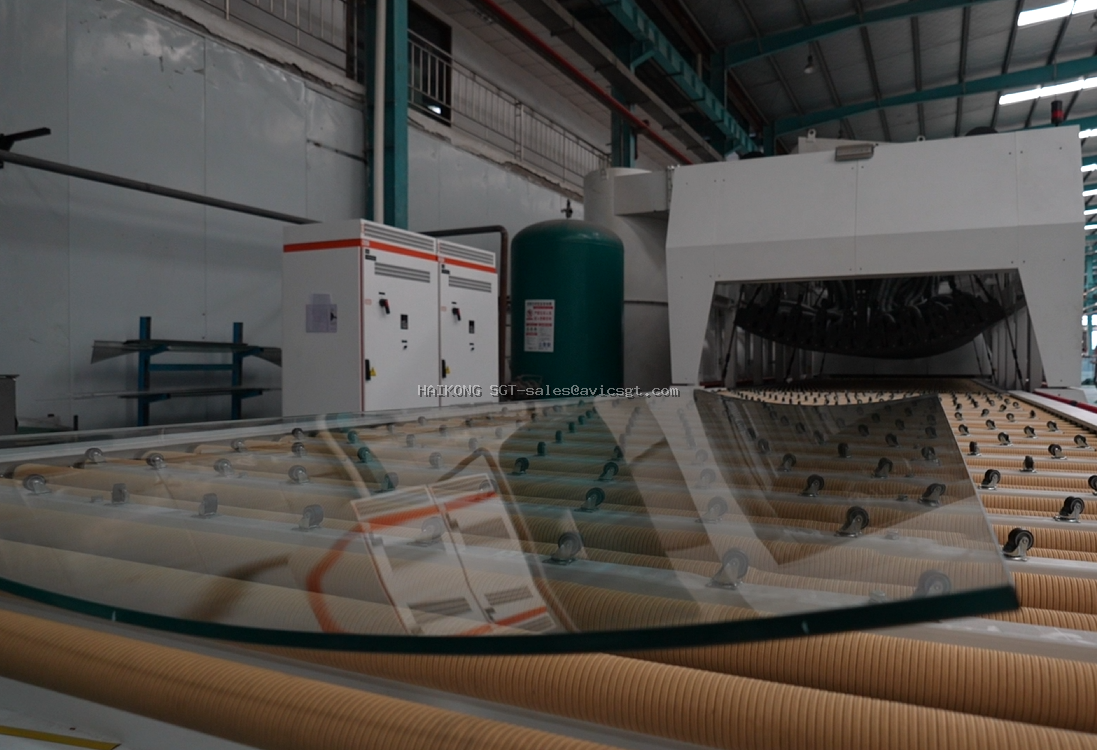
Bent tempered glass (also called curved tempered glass or bent toughened glass) is a type of safety glass that has been both thermally curved and tempered in a single, integrated production process. Unlike flat tempered glass, which is processed on a horizontal roller hearth furnace, bent tempered glass is shaped while hot and then rapidly cooled—all within the same production line.
The Manufacturing Process
Modern horizontal bending and tempering lines typically operate as follows:
Heating: Flat glass is heated to over 630°C (approximately 1,170°F)—until it becomes red hot and pliable.
Bending: Once heated, the glass is moved within the furnace into a bending station, where it is bent to its target radius. The glass can be bent lengthwise (along the glass flow direction) or crosswise (across the glass flow), enabling both cylindrical and more complex curvatures.
Tempering (Quenching): The bent glass is then rapidly cooled by forced air jets—a process called quenching—which traps high compressive stress on the glass surface and tensile stress in the interior.
Finished Product: The bent and tempered glass exits the furnace as a finished safety glass product, ready for inspection, lamination, or installation.
It was not until the 1990s, with the development of the first horizontal tempering machine featuring an integrated bending furnace, that bent tempered glass with sufficiently good optical quality became generally available. Since then, continuous advancements in heating control, bending accuracy, and quenching technology have pushed the boundaries of what is possible—from simple cylindrical bends to complex double-curved geometries.
Advantages of Bent Tempered Glass
Bent tempered glass offers a compelling combination of properties that make it the preferred choice for demanding architectural applications:
1. Safety Glass Classification
The most important advantage: bent tempered glass is safety glass. When broken, it shatters into small, blunt granular pieces rather than large, razor-sharp shards. This makes it the most practical type of curved glass for applications where safety is paramount—windows, curtain walls, balustrades, and skylights.
2. Superior Strength
Bent and tempered glass offers significantly greater resistance to mechanical and thermal loads compared to bent annealed glass. In fact, tempered bent glass withstands up to five times more mechanical strain than bent annealed glass, making it far more useful for structural applications. The curved shape itself also minimizes deflections, as the arched geometry naturally resists bending forces.
3. Thermal Stability
The tempering process imparts excellent durability against temperature variations, making bent tempered glass suitable for exterior applications exposed to direct sunlight, sudden temperature changes, and extreme weather conditions.
4. Design Freedom
Bent tempered glass brings elegance and energy to any designed space. It can be produced in cylindrical curves (single-axis bends) and, with advanced technology, even in double-curved geometries that combine curvature in two directions. This flexibility allows architects to realize flowing, organic forms that were previously impossible or prohibitively expensive.
5. Cost-Effectiveness for Large Volumes
For projects requiring curved glass at scale, bending and tempering is generally more cost-effective than hot bending followed by lamination, as the entire process is completed in a single production run without additional lamination steps.
Disadvantages and Challenges of Bent Tempered Glass
Despite its many advantages, bent tempered glass has inherent limitations that specifiers must understand:
1. Optical Distortion
The rapid cooling (quenching) process creates a degree of optical distortion that is inherent to all thermally tempered glass. In curved tempered glass, this manifests as:
Roller wave: A periodic waviness introduced during the tempering process, caused by glass exit temperature, roller pitch, and oscillation speed.
Wind spots (anisotropy): Localized stress variations visible as rainbow-like patterns under polarized light.
Reflective distortion: Reflected images may appear wavy or distorted when viewed from certain angles.
While some optical distortion is inevitable in bent tempered glass, modern manufacturing controls can keep these effects within acceptable tolerances. For applications requiring exceptional optical clarity, such as high-end display cases, hot bending glass (which cools slowly) may be preferable, though it lacks safety glass properties.
2. Limited Post-Processing
Like flat tempered glass, bent tempered glass cannot be cut, drilled, or modified after tempering. All fabrication—edge polishing, hole drilling, notch cutting—must be completed before the glass enters the bending and tempering furnace.
3. Size and Shape Limitations
Bent tempered glass has constraints on maximum size, weight, glass thickness, and the complexity of achievable curvatures. While modern technology has dramatically expanded these limits, extreme double-curved forms or very tight radii still require specialized equipment and careful design coordination.
4. Coating Limitations
Low-E coatings and other surface treatments cannot be applied after bending. Instead, hard or soft coatings must be applied to the flat glass before the bending and tempering process, requiring careful coordination between coating and bending parameters.
5. Handling Complexity
Bent glass cannot be handled with standard flat glass suction cups. Special suction cups with a deeper well are required to provide proper grip around the glass radius, adding complexity to installation.
The Challenge of NiS Spontaneous Breakage and Heat Soak Testing for Bent Glass
Like all thermally toughened glass, bent tempered glass is susceptible to spontaneous breakage caused by nickel sulfide (NiS) inclusions—microscopic impurities that can form during the float glass manufacturing process. When glass containing NiS is heated during tempering, the inclusions expand. Under the high internal tension of tempered glass, this expansion can lead to delayed fracture—sometimes months or years after installation, when the glass is already in service.
The most effective method to mitigate NiS risk is the Heat Soak Test (HST) , specified under European standard EN 14179-1. In this test, tempered glass is heated to approximately 290°C for a specified period, accelerating the NiS phase transformation so that defective panels break in the factory rather than on the building.
The Bent Glass Heat Soak Dilemma
Here is a critical industry reality: EN 14179-1, the European standard for heat soak testing, explicitly states that curved heat soaked thermally toughened safety glass is not part of this standard. Annex B of the standard contains information on curved glass, but the product itself is not covered under the standard’s formal scope.
This regulatory gap, combined with technical and economic realities, means that many glass processors do not offer heat soak testing for bent tempered glass at all. The reasons are straightforward:
Low loading efficiency: Bent glass panels have irregular shapes and varying curvatures, making them difficult to pack efficiently in a heat soak furnace. Unlike flat glass, which can be stacked tightly, curved panels occupy far more space per unit of glass area. Flat glass tempering furnaces typically operate at around 65% loading efficiency at best. For bent glass in a heat soak furnace, the efficiency drops even further.
Extended cycle times: Low loading density forces longer heating cycles to ensure uniform temperature distribution, reducing throughput and increasing energy consumption.
High cost: The combination of low throughput and high energy consumption makes heat soaking curved glass significantly more expensive than heat soaking flat glass—often prohibitively so for many manufacturers.
Risk of damage: Handling curved panels for HST introduces additional handling steps, increasing the risk of edge damage or breakage before the glass even reaches the building site.
As a result, many glass manufacturers simply decline to perform heat soak testing on curved tempered glass, accepting the residual NiS risk rather than absorbing the substantial costs and operational challenges.
How SGT Solves the Bent Glass Heat Soak Challenge
At Guangdong HAIKONG Special Glass Technology CO., LTD (SGT) , we take a different approach.
While many manufacturers refuse to perform heat soak testing on curved tempered glass due to low loading efficiency and high cost, SGT does it.
We believe that the safety of a building’s occupants should not be compromised by production economics. Our commitment to quality extends to every product we manufacture, including bent tempered glass for demanding architectural applications.
Whether your project requires cylindrical curved glass for a sweeping facade, complex double-curved panels for a signature architectural feature, or laminated bent glass assemblies for overhead glazing, SGT offers:
Heat soak testing for bent tempered glass upon customer request, conducted in properly calibrated HST ovens
Stringent quality control throughout the bending and tempering process, from raw material selection to final inspection
Customizable solutions including laminated bent glass (PVB or SGP interlayers) for fall protection, and insulating glass units (IGUs) with curved panes for thermal performance
Our ability to provide heat-soaked bent tempered glass gives architects and building owners peace of mind, knowing that their curved glass installations carry the lowest possible risk of NiS-induced spontaneous breakage—even years after installation.
Bent Tempered Glass vs. Hot Bending Glass
To make an informed specification, it is essential to understand the distinction between bent tempered glass and hot bending glass:
| Feature | Heat Bending Glass | Bent Tempered Glass |
|---|---|---|
| Production Process | Heated, slowly bent into shape, then gradually cooled (annealed) | Heated, bent, and rapidly cooled (quenched) for added strength |
| Strength | Same strength as regular annealed glass | 4–5 times stronger than regular glass |
| Breakage Behavior | Shatters into large, sharp pieces (unless laminated) | Shatters into small, blunt pieces—safety glass |
| Optical Quality | Generally better optical clarity with fewer distortions | Minor optical distortions possible due to rapid cooling |
| Safety Classification | Not safety glass (unless laminated) | Safety glass by definition |
| Design Flexibility | High—ideal for complex or custom curves | Moderate—used where strength and safety are required |
| Cost | Generally more expensive due to molds and manual processing | Typically less expensive for volume production |
| Best Applications | Decorative elements, custom furniture, artistic designs | Structural facades, balustrades, skylights, safety-critical applications |
Hot bending glass (also called slump bending or gravity bending) uses molds and slow cooling to achieve precise curvatures with excellent optical quality. However, it is not safety glass unless laminated. Bent tempered glass, while having some optical distortion, delivers the strength and safety fragmentation required for structural and exterior applications.
Applications of Bent Tempered Glass in Architecture
Bent tempered glass is transforming both exterior and interior design. Its versatility makes it a preferred choice for:
Exterior Applications
| Application | Why Bent Tempered Glass |
|---|---|
| Curtain walls and facades | Sweeping curved glass facades create dramatic architectural statements; strength withstands wind loads |
| Skylights and canopies | Safety fragmentation protects people below; thermal stability resists solar heat gain |
| Solariums and conservatories | Curved forms maximize light capture; strength supports roof loads |
| Building entrances | Full-height curved glass entrances create welcoming, transparent portals |
Interior Applications
| Application | Why Bent Tempered Glass |
|---|---|
| Stair railings and balustrades | Strength meets safety; curved glass follows staircase geometry |
| Glass partitions | Seamless curved dividers create fluid spaces |
| Elevator surrounds | Bent glass enclosures add sophistication |
| Retail displays and showrooms | Curved glass showcases products while maintaining safety |
Landmark Projects
High-profile projects worldwide demonstrate the potential of bent tempered glass. For example, the Lusail Towers in Qatar—headquarters of Qatar National Bank and other major institutions—feature an oval facade with spiral curvature, achieved using advanced curved tempered forming technology with arc accuracy deviation controlled to within approximately 1 millimeter.
Conclusion
Bent tempered glass represents the convergence of safety, strength, and design freedom. It enables architects to move beyond flat planes and create buildings that flow, curve, and soar—all while meeting the stringent safety requirements of modern building codes.
However, specifying bent tempered glass requires understanding its limitations: inherent optical distortion, the inability to post-process, and the challenge of NiS spontaneous breakage. For projects where long-term reliability is paramount, heat soak testing is the industry’s most effective risk mitigation tool—yet many manufacturers refuse to offer it for curved glass.
SGT is different. We do bent tempered glass heat soak testing. We do it because safety matters. And we do it because our clients deserve nothing less.
Contact SGT today to discuss your curved glass project—whether you need cylindrical bends, double-curved panels, laminated assemblies, or heat-soaked bent tempered glass for maximum reliability.



Reviews
There are no reviews yet.