
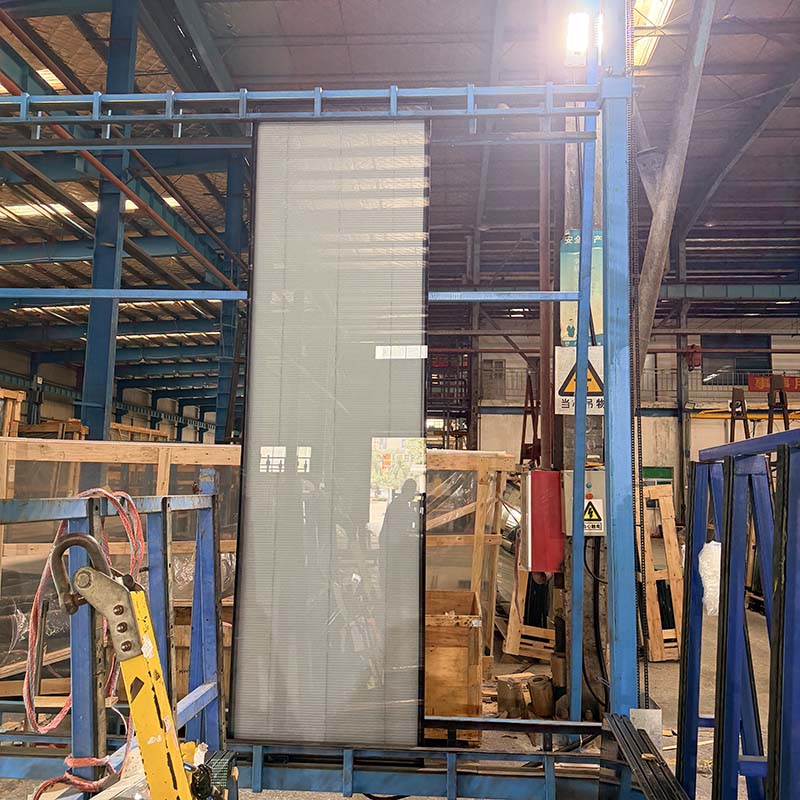
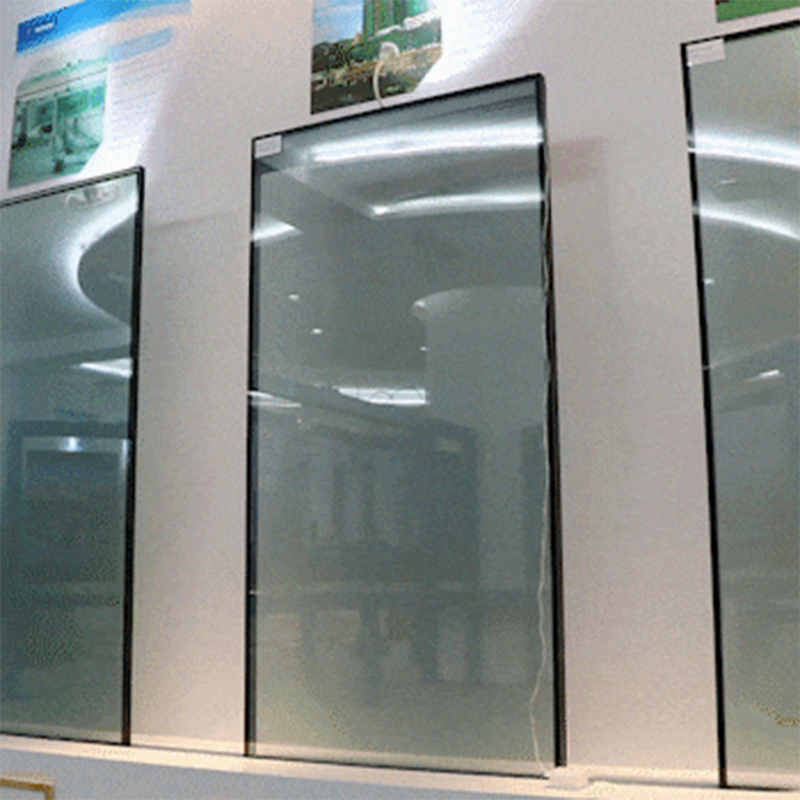
PRODUCT DETAILS
| Parameter | Specification |
|---|---|
| Product | Insulating Glass with Built-in Blinds (Electric / Solar) |
| Minimum Size (mm) | 210 × 350 |
| Maximum Size (mm) | 18000 × 3300 |
| Single Glass Thickness (mm) | 5 – 25 |
| Total Thickness (mm) | 3 – 45 |
| Insulating Layer Thickness (A) | 12 – 27 (argon gas filling available) |
| Blind Material | Aluminum alloy / Stainless steel / PVC (customizable colors) |
| Blade Adjustment Angle | 0° – 105° |
| Drive Method (Electric Type) | 24V DC motor; supports wall switch, IR/RF remote control, and APP control |
| Power Supply (Solar Type) | Monocrystalline silicon PV panel with lithium battery; no external power required; battery life ≥ 30 days |
| Sound Insulation Performance | ≥ 30 dB |
| Shading Coefficient (SC) | 0.25 – 0.60 (adjustable) |
| Wind Resistance Class | ≥ Class 6 (customizable up to Class 9) |
PROCESSING ROUTE
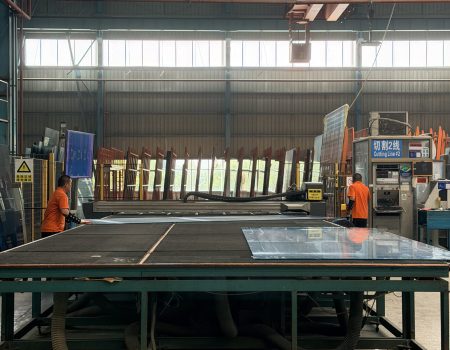
Cutting
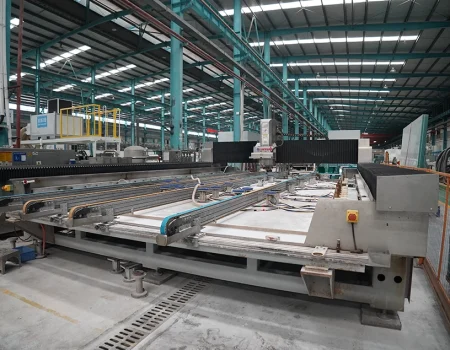
Edging
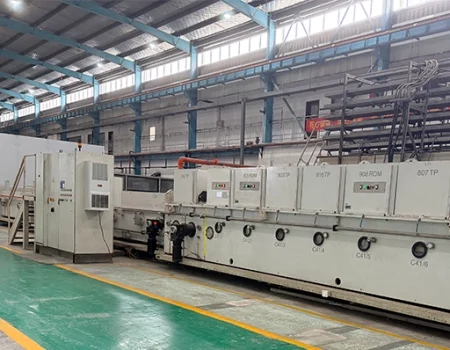
Coating(Optional)
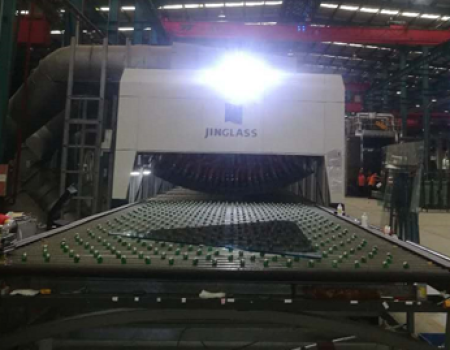
Tempering
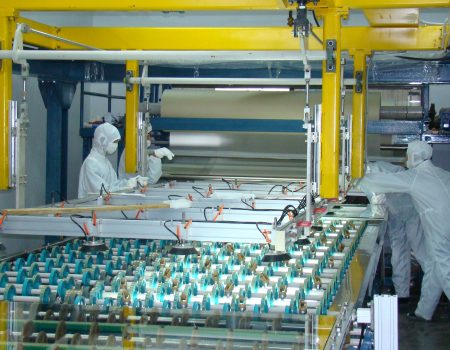
Laminating(optional)
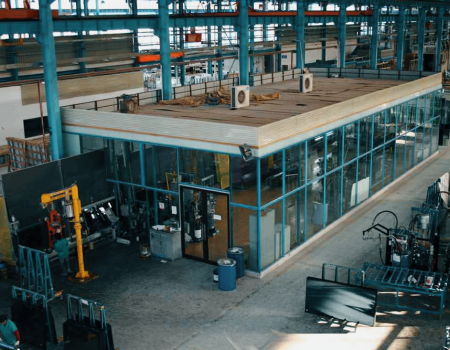
Insulating
Insulated Glass With Internal Blinds: All-in-One Glazing for Modern Architecture
What Is Insulated Glass With Internal Blinds?
Insulated glass with internal blinds is also known as built-in blind insulating glass, integrated shading glazing, or internal blind IGU. It delivers a ready-to-install glass unit that integrates a shading system inside the sealed cavity between two or more panes.
Unlike conventional window systems, this design removes the need for external or internal blinds and curtains. Instead, it places the blind mechanism inside a fully sealed insulating glass unit (IGU). As a result, the system combines thermal insulation, solar control, privacy, and easy maintenance in one engineered solution.
The cavity between glass layers contains dry air or inert gas such as argon. Inside this space, manufacturers install a blind system. In addition, a magnetic coupling system transfers movement through the glass, so users can operate the blind without breaking the seal.
Therefore, the system eliminates external window treatments completely. For this reason, modern architecture widely adopts it where clean aesthetics and energy efficiency matter. It is also referred to as “double-glazed unit with integrated blind,” “sealed unit with internal venetian blind,” or “built-in blind insulating glass.”
How It Works: Integrated Shading Without Breaking the Seal
Inside an insulated glass with internal blinds unit, the blind system stays fully enclosed within the cavity.
Typically, a 16 mm to 27 mm space houses a micro-venetian blind made from lightweight aluminum alloy.
Two magnetic control handles sit on the external glass surface. One handle lifts and lowers the blind, while the other adjusts slat rotation from 0° to 180°.
When the user moves the external handle, magnetic force passes through the glass. Therefore, the system does not require any physical penetration into the sealed cavity.
Inside the unit, a magnetic follower converts this movement into precise blind operation. As a result, the slats raise, lower, or tilt smoothly.
For electric versions, the system uses a compact low-voltage motor installed inside the sealed unit. Moreover, these systems connect to wall switches, remote controls, or smart building platforms.
Because no mechanical linkage crosses the glass, the insulating cavity remains hermetically sealed throughout its lifespan. Consequently, the system maintains inert gas stability, prevents condensation, and protects the blind from dust and moisture.
Key Benefits of Insulated Glass With Internal Blinds
1. Thermal Control and Energy Savings
Insulated glass with internal blinds delivers strong thermal performance.
A standard double-glazed unit typically achieves around 2.8 W/m²·K. However, when users activate internal blinds, heat transfer decreases significantly.
In practice, performance reaches 1.8 W/m²·K. Moreover, triple glazing systems can drop below 1.7 W/m²·K.
During summer, closed slats reflect solar radiation. As a result, indoor heat gain drops and air-conditioning load decreases.
During winter, users can keep blinds open to maximize sunlight. Meanwhile, the IGU continues to prevent heat loss.
The shading coefficient ranges from Sc = 0.18 (fully closed) to Sc = 0.90 (fully open), which allows precise solar control.
2. Exceptional Acoustic Insulation
This system also improves sound insulation performance.
Standard double glazing reduces noise by around 25 dB. In contrast, internal blinds increase performance to 30–36 dB depending on configuration.
Therefore, it works well in environments near highways, railways, or airports where noise control is critical.
3. Clean Surface and No Maintenance
Maintenance becomes extremely simple.
Because the blind stays sealed inside the IGU, it does not collect dust, grease, or smoke particles.
Unlike traditional blinds that require frequent cleaning, this system only requires glass surface cleaning.
As a result, users save both time and long-term maintenance costs.
4. Fire Safety
This system also improves fire safety performance.
It eliminates fabric materials that may support flame spread.
Instead, it uses non-combustible aluminum alloy components fully enclosed within tempered glass.
Therefore, it does not produce smoke or contribute to fire propagation.
5. Security Performance
No cords, chains, or external mechanical parts remain exposed.
As a result, the system reduces tampering risks and improves security.
In addition, multi-layer tempered glass increases resistance against forced entry.
6. Space-Saving and Modern Aesthetics
This system removes the need for curtains or external blinds.
Therefore, it increases usable interior space and supports minimalist architectural design.
From the exterior, the façade remains clean and uninterrupted. Meanwhile, interiors stay free of rods, cords, or visible hardware.
Control Options: Manual, Electric, Smart
Manual Magnetic Control
This option remains the most widely used because it is simple and reliable.
Two magnetic handles attach directly to the glass surface without drilling or screws.
One handle controls vertical movement. The other adjusts slat angle.
Users can reposition or remove the handles easily. In addition, the system requires no power supply.
Electric Motorized Control
For large glass panels or skylights, electric control provides better performance.
Manufacturers integrate a 24V DC motor inside the sealed unit.
Importantly, no external wiring passes through the glass, so insulation integrity remains intact.
Users can operate the system through wall switches, remote controls, or building automation systems.
Moreover, the system runs quietly and often includes overload protection.
Smart and Solar-Powered Control
Advanced versions use solar-powered technology.
A photovoltaic module charges an internal battery using ambient light.
Users can control the system through mobile apps or voice assistants such as Alexa or Google Assistant.
As a result, this solution fits smart buildings and supports LEED or BREEAM certification goals.
Technical Specifications
| Parameter | Typical Values |
|---|---|
| Glass configuration | 5 + 19A + 5 to 6 + 27A + 6 (double); triple glazing available |
| Glass type | Clear float, low-iron, Low-E, tinted, patterned |
| Safety glass | Tempered standard; laminated or heat-strengthened optional |
| Cavity width | 16 mm to 27 mm |
| Gas fill | Dry air or ≥90% argon |
| Thermal transmittance | Down to 1.8 W/m²·K |
| Shading coefficient | 0.18 to 0.90 adjustable |
| Acoustic insulation | 30–36 dB |
| Blind material | Aluminum alloy, non-corrosive, non-combustible |
| Slat width | 12.5 mm / 15 mm / 16 mm |
| Control type | Manual, electric, smart solar-powered |
| Mechanical durability | ≥30,000 cycles raise/lower; ≥60,000 tilt cycles |
| Max panel size | ≤2.4 m width, ≤3.6 m height |
| Min panel size | ≥300 mm × 300 mm |
| Certifications | CE, IGCC, 3C, JG/T 255-2020 |
Applications of Insulated Glass With Internal Blinds
This system combines thermal performance, acoustic insulation, low maintenance, and design flexibility. Therefore, it fits a wide range of buildings.
In high-end residential projects, it is widely used in living rooms, bedrooms, and home offices. Homeowners value instant privacy control without curtains.
In commercial offices, it improves glare control and acoustic comfort. Moreover, electric systems allow centralized control across entire buildings.
Healthcare facilities benefit from its hygienic design. Because the blinds remain sealed, the system eliminates dust accumulation and improves sanitation.
Hotels and hospitality projects use it to reduce housekeeping workload. At the same time, it enhances interior aesthetics.
Educational buildings apply it to improve classroom lighting control. In addition, it reduces maintenance compared to traditional blinds.
Transport hubs such as airports and railway stations use large-scale installations. As a result, they reduce cooling loads in large public spaces.
Food service and laboratory environments benefit from non-porous glass surfaces. Meanwhile, the sealed structure prevents contamination.
High-security buildings also prefer this system because it has no exposed components and offers strong structural resistance.
Limitations to Consider
Although the system offers many advantages, several limitations still apply.
Cost: The system costs more than standard IGUs. However, lifecycle savings often compensate for the initial investment.
Repairability: Manufacturers cannot repair internal mechanisms on site. Instead, users must replace the entire unit if failure occurs. Therefore, product quality matters greatly.
Weight: The system weighs more than standard glazing. As a result, frames and hinges must support additional load.
Frame depth: Deeper frames are required to accommodate the blind cavity. Consequently, retrofit projects may require full frame replacement.
Not full blackout: Even when fully closed, small light leakage may occur. Therefore, special applications may still require additional blackout solutions.
Conclusion
Insulated glass with internal blinds delivers a fully integrated architectural glazing solution.
It combines thermal efficiency, acoustic performance, safety, privacy, and aesthetics in one system. At the same time, it eliminates the need for traditional window coverings.
When manufacturers properly engineer and test the system, it provides long-term stability and reduced maintenance.
Therefore, architects, developers, and building owners gain a future-ready glazing solution that balances performance, design, and operational efficiency.



Reviews
There are no reviews yet.